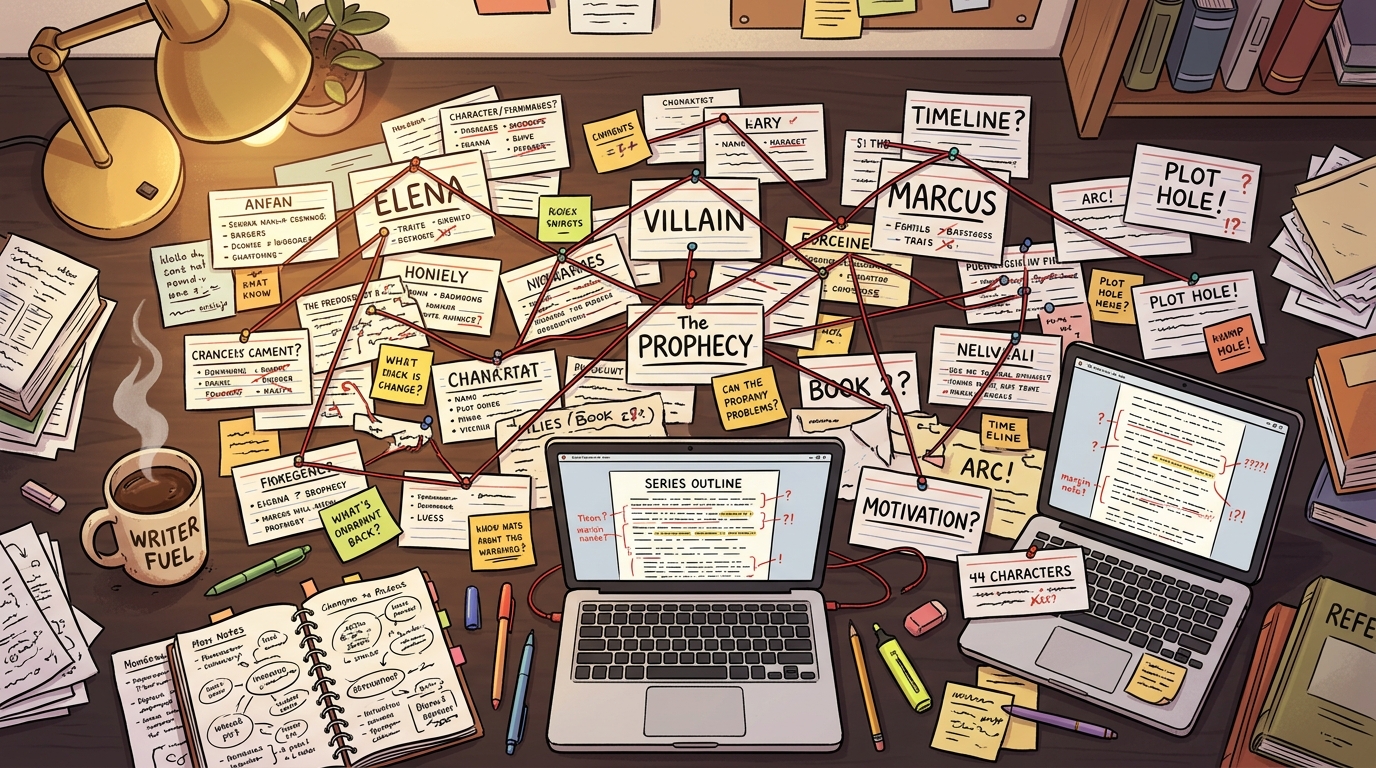
You had a plan.
When you started your series, you knew every character. You knew Marcus was left-handed. You knew Elena had green eyes. You knew that the blacksmith in the village on the western border owed a debt to the captain of the guard from an incident fourteen years before the story began.
Then you wrote book two. And somewhere around chapter eight, Marcus became right-handed. Elena's eyes turned blue. The blacksmith vanished entirely and nobody mentioned the debt again.
You didn't mean for it to happen. You just forgot.
If you've written more than 50,000 words in a single universe, whether that's a trilogy, a ten-book series, or a sprawling epic fantasy with a cast that rivals Game of Thrones, you've felt the weight of character tracking crush you from above. It starts small. A misremembered hair color. A contradicted timeline. A relationship that made sense in book one but doesn't hold up by book four.
By the time you notice, it's embedded in your published manuscript and your readers are emailing you about it.
Here's how professional authors with casts of 50, 100, even 200+ characters keep it all straight, and how you can do the same thing, starting today.
Why Spreadsheets Break Down (and Why You're Not the Problem)
The first thing most writers do when they realize they need a tracking system is open a spreadsheet. Name, age, appearance, first mentioned, last seen. Neat little rows and columns.
This works until it doesn't. And it stops working fast.
Here's why: characters aren't rows. They're nodes in a web. Marcus isn't just "Marcus, age 34, left-handed, scar on chin." Marcus is:
- The mentor who trained Elena (who later betrays his philosophy in book 3)
- The son of the woman who founded the Order (which is dissolving in book 4)
- The only person who knows the blacksmith's secret (which drives the subplot in book 2)
- Someone whose worldview shifts from idealist to pragmatist across 300,000 words
A spreadsheet can hold the first version. It can't hold the second. Characters exist in relationship to other characters, to events, to the world itself. The moment you try to track connections in a flat table, you're fighting the tool instead of writing.
That's not a you problem. That's a tool problem.
The Atomic Approach: What Actually Works
The writers who manage massive casts without losing their minds (the Brandon Sandersons, the George R.R. Martins, the Tolkiens) all do some version of the same thing, whether they know it or not.
They break their story world into atomic elements.
Not "character sheets." Not "world bibles." Atomic elements: the smallest meaningful unit of story information, tracked independently but connected to everything it touches.
Here's what that looks like in practice:
1. Character Identity (The Basics That Never Change)
Start with the immutable facts. Things that, once established, should never contradict:
- Full name and aliases
- Physical description (the details you've committed to in text)
- Age or age-relative markers ("older than Elena by a decade")
- Distinguishing traits mentioned on-page
The key word is on-page. If you wrote that Marcus has a scar on his left hand in chapter three, that's canonical. It goes in the identity record. If you've only imagined it but never written it, it stays in your head until you commit it to prose.
2. Character Relationships (The Web)
This is where spreadsheets die. Every character exists in a web of relationships, and those relationships change.
Track them as pairs with context:
- Marcus → Elena: Mentor (Books 1-2), Estranged (Book 3), Reconciled (Book 4)
- Marcus → Thorne: Rivals since the academy. Thorne doesn't know Marcus was responsible for the incident.
- Elena → The Order: Loyal member (Book 1), Disillusioned (Book 2), Active dissident (Book 3)
Notice the progression. Relationships aren't static. The best series have relationships that evolve, and the best tracking systems capture when they change and why.
3. Character Arcs (The Trajectory)
Separate from relationships. An arc is the internal journey:
- Marcus: Idealist → Compromised leader → Broken → Rebuilt with humility
- Elena: Follower → Independent thinker → Revolutionary → (what comes next?)
When you can see the arc laid out, you can spot problems before they reach the page. If Marcus is supposed to be "broken" in book 3 but you just wrote a scene where he's cracking jokes and inspiring troops, something's off.
4. What They Know (Knowledge State)
This is the one most writers miss, and it's the one that creates the worst plot holes.
At any given point in your story, each character has a specific set of knowledge. Marcus doesn't know that Elena met with the rebels. The blacksmith doesn't know that his secret was overheard. The reader knows all of it, and that dramatic irony is powerful, but only if you track who knows what and when they learned it.
Map it:
- Marcus learns about the rebellion: Book 3, Chapter 12 (told by Thorne)
- Elena learns Marcus knew about her father: Book 4, Chapter 3 (discovers the letter)
- The reader learns the blacksmith's secret: Book 2, Chapter 8
If Elena confronts Marcus about something she hasn't learned yet, your readers will catch it. Every time.
5. Timeline Anchoring
Every character event needs a place in time. Not necessarily a date, but a relative position.
- Before the war / During the siege / After the fall
- "Three months before Elena arrived"
- "The same night the beacon was lit"
When you anchor events to your timeline, you prevent the impossible: a character showing up somewhere they can't be, a pregnancy lasting fourteen months, a journey that takes three days in one chapter and three weeks in another.
The Method: Building Your Living Story Bible
Here's a system you can start today, regardless of where you are in your series.
Step 1: Audit What Exists
Go through your published or drafted chapters. Pull out every character mentioned by name. Yes, even the innkeeper with one line in chapter four. If they have a name, they go on the list.
For a 50-character cast, this takes 2-3 hours. It's tedious. Do it anyway.
Step 2: Build the Identity Layer
For each character, document only what's been written on-page. Not what you imagine. What's canonical. If you haven't described their eye color, leave it blank. That's a feature, not a bug. Blank spaces mean you haven't committed yet, which means you still have flexibility.
Step 3: Map the Relationships
Draw the connections. Every character who interacts with another character gets a relationship entry. Include the nature of the relationship and when it changes.
This is where you'll start finding problems. "Wait, did Marcus actually meet the blacksmith? Or did I just assume they knew each other?" Good. Finding those gaps now saves you a rewrite later.
Step 4: Track the Arcs
Write one sentence per book (or per act) describing each major character's internal state. Where are they emotionally? What do they believe? What have they lost?
When you see the sentences side by side, the arc reveals itself, or reveals that there isn't one yet.
Step 5: Document the Knowledge State
For your major characters (top 10-15), track the critical pieces of information they possess at each story milestone. Focus on the secrets, the revelations, and the moments where a character learns something that changes their behavior.
Step 6: Keep It Alive
This is the part that separates writers who track from writers who track well. Your story bible isn't a document you build once and reference. It grows with every chapter you write. Every new scene potentially introduces a new relationship, shifts an arc, or reveals information to a character.
Build the habit: after finishing a chapter, spend ten minutes updating your character tracking. Add new connections. Note any changes. Flag any contradictions you noticed while writing.
Scaling Past 50 Characters
At 50 characters, this system is manageable with discipline. At 100, it's a real challenge. At 200, the scale of something like Wheel of Time or Malazan, it becomes a full-time job alongside the actual writing.
This is where tools matter. Not generic tools. Tools built for this specific problem.
A writing tool that understands story structure can maintain these connections for you. It can flag when you're about to contradict something you wrote three books ago. It can tell you what a character knows and doesn't know at any point in the timeline. It can hold the entire web of relationships in memory while you focus on what you actually want to be doing: writing.
That's why we built the Atomic Writing Elements system inside EpicWrite. AWE breaks your story into exactly these elements (characters, relationships, arcs, knowledge states, timelines, world rules) and maintains them as a living, structured knowledge graph that grows as you write. You can be 200,000 words deep into a series and ask about a side character from book one, and the system knows exactly who they are, what they did, and how they connect to your current chapter.
But whether you use EpicWrite or build your own system with notebooks and spreadsheets and sheer willpower, the principle is the same: break it down into atoms, track the connections, and keep it alive.
Your readers are paying attention to every detail. Your tracking system should be too.
The Payoff
Here's what happens when you get this right:
A reader finishes book four of your series. They go back to book one and re-read it. And they find a throwaway line in chapter six, a detail about the blacksmith's apprentice, that suddenly means something completely different now that they know what happens in book four.
They didn't notice it the first time. But you did. Because you tracked it. Because that detail wasn't an accident. It was a planted seed that paid off 300,000 words later.
That's the kind of writing that turns readers into fans. Not just readers who finish your series, but readers who recommend it to everyone they know.
And it starts with knowing that Marcus is left-handed.
Tim Monaghan is the founder of EpicWrite, an AI writing platform built to help authors maintain story consistency across 500,000+ words. He's a developer with 10+ years in IT who couldn't find a tool that didn't forget everything by chapter five, so he built one.
Written with EpicWrite - AI-powered creative writing platform